
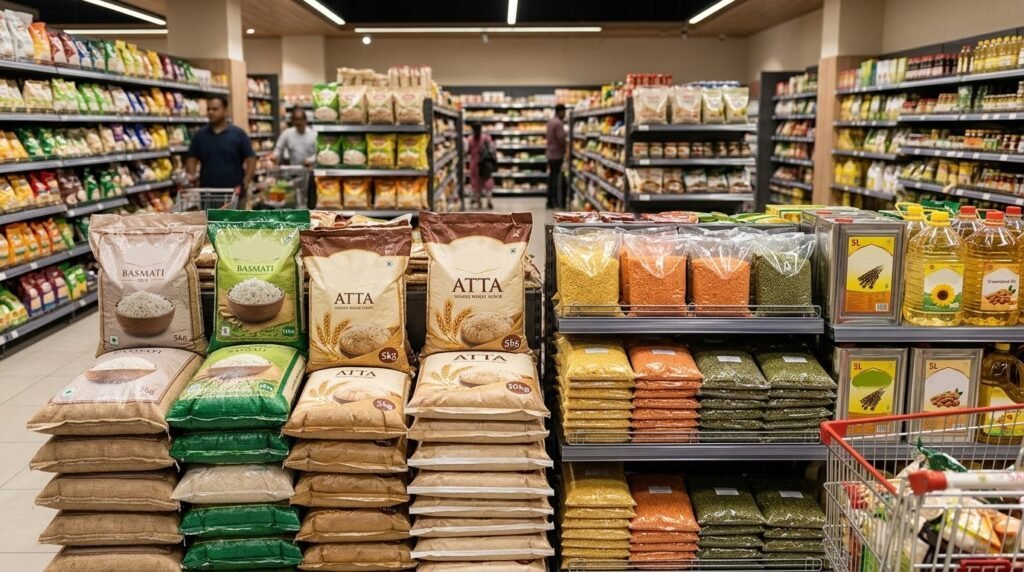
Planning a month’s groceries sounds easy until you start asking practical questions:
How much rice will we actually use?
Should we buy 5 kg or 10 kg of atta?
How much dal should a family of four keep at home?
Is a large bottle of cooking oil enough for 30 days?
There is no single quantity that works for every Indian household.
A family of four that eats rice twice a day can use more rice than a family of six that mostly eats rotis. A couple cooking every meal at home may use more groceries than a larger family that eats lunch outside five days a week.
That is why the most reliable monthly Indian grocery calculator starts with your actual household consumption rather than a fixed family-size chart.
The easiest formula is:
Your Typical Weekly Usage × 4.3 = Estimated 30-Day Requirement
Use that calculation for rice, atta, dal, cooking oil and other frequently used staples, then adjust for travel, guests, eating out and pack sizes.
This guide shows you how to do that for households of 2, 4 or 6 people, while also helping you decide which groceries belong on a monthly shopping trip and which are better purchased weekly or only when they run low.
Quick Answer: How to Calculate a 30-Day Indian Grocery List
Before your next grocery trip, track one normal week of cooking.
Write down approximately how much your household uses of:
- Rice
- Atta
- Dal and pulses
- Cooking oil
- Poha
- Suji
- Besan
- Tea or coffee
Then use:
Weekly Usage × 4.3 = 30-Day Estimate
For example, if your family uses 2 kg of rice in one normal week:
2 kg × 4.3 = 8.6 kg rice for 30 days
If you normally buy rice in 5 kg bags, you might choose the pack size closest to your calculated requirement rather than automatically buying a much larger bag.
The same method works whether your household has two people or six.
Why Fixed Family-Size Grocery Numbers Can Be Misleading
A monthly grocery list often looks something like:
Family of 4 = X kg rice + Y kg atta + Z litres oil.
The problem is that family size alone does not tell you how a household eats.
Consider two families of four.
Family A
They eat:
- Rice at lunch
- Rotis at dinner
- Dal several times a week
- Most meals at home
Family B
They:
- Eat lunch at work or school
- Cook rice only two or three times a week
- Order dinner on weekends
- Eat fewer rotis
Both households contain four people, but their 30-day grocery requirements can be completely different.
So use family size as a context, not as the calculator itself.
The 30-Day Rice Calculator
Instead of asking, “How much rice should a family of four buy?”, start with:
How much rice did we actually use this week?
Use this table:
| Rice Used in 1 Week | Approx. 30-Day Requirement |
| 1 kg | 4.3 kg |
| 1.5 kg | 6.5 kg |
| 2 kg | 8.6 kg |
| 2.5 kg | 10.8 kg |
| 3 kg | 12.9 kg |
| 4 kg | 17.2 kg |
| 5 kg | 21.5 kg |
If your household regularly alternates between Basmati, Sona Masoori, Ponni or another rice, calculate each type separately.
Working through an Indian pantry staples checklist beyond rice, atta and dal helps you build a more complete monthly shopping plan.
For example:
Basmati used weekly: 0.5 kg
Everyday rice used weekly: 2 kg
Estimated 30-day requirement:
Basmati: about 2.2 kg
Everyday rice: about 8.6 kg
That is much more useful than buying one oversized rice bag and hoping it works for every dish.
The 30-Day Atta Calculator
Use the same method for atta.
| Atta Used in 1 Week | Approx. 30-Day Requirement |
| 1 kg | 4.3 kg |
| 1.5 kg | 6.5 kg |
| 2 kg | 8.6 kg |
| 2.5 kg | 10.8 kg |
| 3 kg | 12.9 kg |
| 4 kg | 17.2 kg |
| 5 kg | 21.5 kg |
A household that eats rotis at both lunch and dinner will naturally move toward a higher number.
A household that alternates between rice, rotis, dosa, poha and other meals may need considerably less.
Should You Buy a Full Month of Atta at Once?
That depends on:
- How quickly you use it
- Pack sizes available
- Storage conditions
- How much pantry space you have
If your calculation says you need around 9 kg, buying a practical pack close to that amount may make more sense than automatically purchasing 20 or 25 kg.
The 30-Day Dal and Pulses Calculator
Dal is slightly more complicated because most Indian kitchens use more than one type.
Your pantry may include:
- Toor dal
- Moong dal
- Masoor dal
- Chana dal
- Urad dal
- Rajma
- Chole
- Lobia
Instead of calculating each one as though it is eaten daily, calculate total pulses used in a week first.
| Dal & Pulses Used Weekly | Approx. 30-Day Requirement |
| 0.5 kg | 2.2 kg |
| 0.75 kg | 3.2 kg |
| 1 kg | 4.3 kg |
| 1.25 kg | 5.4 kg |
| 1.5 kg | 6.5 kg |
| 2 kg | 8.6 kg |
Then divide that amount among the varieties your household actually cooks.
Example
Suppose a household uses approximately 1 kg of pulses in a normal week.
Monthly estimate:
1 kg × 4.3 = 4.3 kg total pulses
Instead of buying 4 kg of every dal, the monthly mix might be divided according to the family’s cooking habits.
The correct combination depends on whether you frequently cook:
- Toor dal
- Moong dal
- Rajma
- Chole
- Idli or dosa batter
- Dal-based snacks
The calculator should reflect your menu, not somebody else’s pantry.
The 30-Day Cooking Oil Calculator
Cooking oil is another item where fixed family-size recommendations can be misleading.
Different households use very different amounts depending on:
- Frying frequency
- Cooking technique
- Cuisine
- Number of meals prepared
- Whether multiple oils are used
The easiest approach is again to measure one normal week.
| Oil Used in 1 Week | Approx. 30-Day Requirement |
| 250 ml | 1.1 L |
| 500 ml | 2.2 L |
| 750 ml | 3.2 L |
| 1 L | 4.3 L |
| 1.25 L | 5.4 L |
| 1.5 L | 6.5 L |
This is a shopping calculation, not a recommended dietary intake.
If you use multiple oils, such as mustard oil for some dishes and another oil for general cooking, calculate them separately.
Monthly Grocery Calculator for a Family of 2
For a two-person household, the most common mistake is buying large family-size packs simply because they appear economical.
Instead, track one week.
Example Only
Suppose two people use in seven days:
- Rice: 1.2 kg
- Atta: 1 kg
- Dal and pulses: 500 g
- Oil: 350 ml
Their approximate 30-day calculation becomes:
| Item | Weekly Use | 30-Day Estimate |
| Rice | 1.2 kg | 5.2 kg |
| Atta | 1 kg | 4.3 kg |
| Dal & pulses | 0.5 kg | 2.2 kg |
| Oil | 350 ml | About 1.5 L |
This is not a universal family-of-two recommendation.
It is an example showing how the formula works.
A rice-heavy couple could easily use more rice, while a household that eats outside regularly could use less.
Monthly Grocery Calculator for a Family of 4
A family of four can vary enormously depending on whether the household includes:
- Four adults
- Two adults and two young children
- Two adults and two teenagers
Do not automatically calculate four identical adult portions.
Example Only
Imagine a household of four uses in one typical week:
- Rice: 2.5 kg
- Atta: 2 kg
- Dal and pulses: 1 kg
- Oil: 700 ml
The calculation becomes:
| Item | Weekly Use | 30-Day Estimate |
| Rice | 2.5 kg | 10.8 kg |
| Atta | 2 kg | 8.6 kg |
| Dal & pulses | 1 kg | 4.3 kg |
| Oil | 700 ml | About 3 L |
If that same family eats rotis twice daily, their atta requirement could be higher.
If lunch is eaten outside Monday through Friday, both rice and atta use could be lower.
Monthly Grocery Calculator for a Family of 6
For a six-person household, tracking actual consumption becomes even more important because small estimation errors multiply quickly.
Example Only
Suppose a household uses:
- Rice: 4 kg per week
- Atta: 3 kg per week
- Dal and pulses: 1.5 kg per week
- Oil: 1 L per week
The 30-day estimate becomes:
| Item | Weekly Use | 30-Day Estimate |
| Rice | 4 kg | 17.2 kg |
| Atta | 3 kg | 12.9 kg |
| Dal & pulses | 1.5 kg | 6.5 kg |
| Oil | 1 L | 4.3 L |
Again, these are sample calculations rather than fixed recommendations.
A six-adult household can consume significantly more than a household with grandparents and younger children.
Rice-Heavy vs Roti-Heavy Households
Your staple pattern is often more useful than your family size.
If Your Family Is Rice-Heavy
You may use more:
- Everyday rice
- Basmati
- Idli or dosa rice
- Poha
- Rice-based breakfast ingredients
And relatively less atta.
Instead of increasing both rice and atta automatically, shift the monthly purchase toward the food your family actually eats.
If Your Family Is Roti-Heavy
You may use more:
- Whole wheat atta
- Besan
- Multigrain flour
- Flour used for paratha, thepla or poori
and less rice.
If Your Household Eats Both Daily
Track them independently.
Do not assume that because your household needs 10 kg rice, it must also need 10 kg atta.
Each staple should earn its place in the shopping cart.
How Eating Out Changes Your Monthly Grocery Requirement
A family that cooks 90 meals at home in a month needs different quantities from a family that cooks 50.
Ask:
- Does everyone eat breakfast at home?
- Is lunch packed from home?
- Do children eat school lunch?
- Do adults eat at work?
- How often do you order dinner?
- Do you usually eat outside on weekends?
If your next month includes:
- Travel
- Holidays
- Guests
- School breaks
- Religious fasting
- Festivals
adjust the estimate before shopping.
Simple Adjustment Method
If you normally cook dinner seven nights a week but expect to eat out twice weekly next month, your usual grocery requirement may be higher than necessary.
Reduce your estimate rather than buying your normal maximum automatically.
How Children and Teenagers Change the Calculator
A “family of four” is not one standard consumption unit.
Young Children
They may eat smaller portions than adults.
Teenagers
Their portions may be close to or sometimes larger than adult portions depending on appetite and activity.
Older Adults
Meal size and dietary patterns can also differ.
That is why tracking a real week works better than assigning every person the same quantity.
Which Groceries Should You Buy Monthly?
Not everything belongs in one giant monthly purchase.
A more practical Indian grocery system divides items by shopping frequency.
Monthly or Bulk-Friendly Pantry Staples
These may be suitable for monthly purchasing when your household uses them consistently:
- Rice
- Atta
- Dal
- Pulses
- Cooking oil
- Poha
- Suji
- Besan
- Dry beans
- Pasta or noodles
- Packaged staples
Buy according to actual usage and storage capacity.
Check and Restock as Needed
These do not necessarily need a new pack every month:
- Salt
- Sugar
- Tea
- Coffee
- Turmeric
- Red chilli powder
- Coriander powder
- Cumin
- Mustard seeds
- Garam masala
- Whole spices
- Dry fruits
- Pickles
- Papad
Check what is already in your pantry before replacing them.
This prevents six half-used garam masala packets from quietly establishing their own neighborhood.
Buy Fresh Weekly or More Often
Fresh products usually need a shorter shopping cycle:
- Vegetables
- Fruits
- Milk
- Yogurt
- Paneer
- Fresh herbs
- Green chillies
- Curry leaves
- Fresh bread
The exact schedule depends on how quickly your household uses them and the product’s storage requirements. A simple weekly shopping routine makes this cycle easier to maintain, and it also helps to know how fresh stock is rotated in store.
Build Your Own 30-Day Grocery Calculator
Here is the most reliable process.
Step 1: Take Inventory
Before measuring new consumption, check what you already have.
Write down:
- Rice
- Atta
- Dal
- Oil
- Spices
- Breakfast staples
Step 2: Track One Normal Week
Record what your household actually uses.
Do not choose a festival week, vacation week or unusual week if you want a normal monthly estimate.
Step 3: Multiply by 4.3
Use:
Weekly Usage × 4.3
Step 4: Subtract Existing Stock
If your calculator says you need 9 kg of rice but you still have 3 kg:
9 kg − 3 kg = 6 kg to buy
This step alone can prevent a surprising amount of duplicate purchasing.
Step 5: Adjust for Next Month
Consider:
- Guests
- Travel
- Eating out
- Festivals
- School holidays
- Special meals
Step 6: Match the Result to Available Pack Sizes
If you calculate 8.6 kg atta and the store offers convenient pack sizes around that amount, choose the most practical combination rather than automatically jumping to the largest bag.
Metric and Pound Conversion for Grocery Shopping
If your grocery store uses pounds rather than kilograms, remember:
1 kg ≈ 2.2 lb
Useful approximations:
| Kilograms | Approx. Pounds |
| 1 kg | 2.2 lb |
| 2 kg | 4.4 lb |
| 5 kg | 11 lb |
| 10 kg | 22 lb |
| 20 kg | 44 lb |
This is especially useful when comparing Indian grocery pack sizes in the United States.
How to Plan Spices Without Overbuying
Spices do not need the same calculator as rice and atta.
A household may use coriander powder quickly but take months to finish cloves or cardamom.
Instead of creating a monthly kilogram target, divide spices into:
Frequently Used
Examples:
- Turmeric
- Red chilli powder
- Coriander powder
- Cumin
Check these regularly.
Used Occasionally
Examples:
- Garam masala
- Chaat masala
- Black pepper
- Mustard seeds
Replace only when needed.
Small-Quantity Whole Spices
Examples:
- Cardamom
- Cloves
- Cinnamon
Buying oversized quantities only makes sense if your household actually uses them frequently. If you are still building your spice rack, start with the most essential Indian spices rather than buying everything at once.
Monthly Grocery Budget: Calculate It From Quantity, Not Percentages
Instead of assuming that a fixed percentage of your budget should go to rice, produce or snacks, calculate the budget from your actual list.
Use:
Quantity Needed × Current Unit Price = Estimated Monthly Cost
For example:
If your calculation says you need around 10 kg of a particular rice, compare:
- 5 kg pack price
- 10 kg pack price
- Larger pack price
- Price per kilogram or pound
A bigger bag is valuable only when:
- The unit price is better
- You will actually use it
- You can store it properly
Bulk buying is not a bargain if half the product sits unused. Before finalising quantities, it also helps to check the current weekly specials, since a discounted pack size can change which option works out cheaper per kilogram.
Storage Tips for Monthly Indian Groceries
Buying a month of staples works only if you can store them properly.
Rice and Dal
Keep them:
- In clean, dry containers
- Away from moisture
- Away from direct sunlight
- In a cool, dry pantry area
Inspect your stock periodically and use older products before newly purchased ones.
Atta
Store atta:
- In a tightly closed container
- Away from heat and moisture
- According to package directions
Do not buy significantly more than your household can use comfortably just because a larger bag exists.
Cooking Oil
Keep cooking oil:
- Tightly closed
- Away from direct sunlight
- Away from heat sources
Follow storage instructions on the package.
Spices
Protect spices from:
- Heat
- Moisture
- Excess light
- Open-air exposure
Smaller quantities can make sense for spices your household uses slowly.
Printable 30-Day Indian Grocery Checklist
Monthly Staples
- Rice
- Atta
- Dal
- Pulses and beans
- Cooking oil
- Poha
- Suji
- Besan
- Other grains used regularly
Pantry Check
- Salt
- Sugar or jaggery
- Tea
- Coffee
- Turmeric
- Red chilli powder
- Coriander powder
- Cumin
- Mustard seeds
- Garam masala
- Whole spices
- Dry fruits and nuts
- Pickles
- Papad
Breakfast and Quick-Meal Items
- Oats
- Vermicelli
- Cereal
- Instant mixes
- Bread
- Peanut butter or spreads
- Noodles or pasta
Weekly Fresh Shopping
- Vegetables
- Fruits
- Milk
- Yogurt
- Paneer
- Fresh herbs
- Green chillies
- Curry leaves
Before Checkout
- Existing pantry stock checked
- Weekly usage multiplied by 4.3
- Travel/eating-out days considered
- Guests or festivals considered
- Pack sizes compared
- Unit prices compared
- Storage space checked
Monthly Grocery Shopping at Subzi Mandi
Once you know how much your household actually needs, shopping at an Indian grocery store in Iselin becomes much simpler.
Instead of walking into the store with a vague plan to “stock up,” you can shop by quantity and purpose.
For example:
Need rice?
Know whether you need everyday rice, Basmati, Idli Rice or another variety before choosing a bag.
Need atta?
Calculate roughly how much your household uses rather than choosing pack size only by price.
Need dal?
Divide your total monthly pulse requirement among the varieties your family actually cooks.
Need spices?
Check existing stock first.
At Subzi Mandi, shoppers can build their monthly Indian grocery trip around staples, dals, flours, spices and other everyday cooking essentials while choosing quantities that fit their own household.
Specific brands, pack sizes and availability can change, so compare the current options when you shop.
Frequently Asked Questions About Monthly Indian Grocery Planning
How much rice does a family of 4 need for one month?
There is no reliable universal number.
Track how much rice your family uses during one normal week and multiply it by 4.3.
For example, if you use 2.5 kg weekly:
2.5 × 4.3 = approximately 10.8 kg for 30 days.
Adjust for eating out, guests and existing pantry stock.
How much atta does a family of 4 need monthly?
Use the same formula:
Weekly atta usage × 4.3
If your family uses 2 kg per week:
2 × 4.3 = approximately 8.6 kg per month.
Roti-heavy households may use more.
How much dal should a family buy for one month?
Track the total quantity of dal and pulses used in one week.
If your household uses 1 kg per week, that equals approximately:
4.3 kg for 30 days.
Then divide the total among the dals and beans your family normally cooks.
How much cooking oil does a family need per month?
Oil use varies significantly by cooking style.
Measure one typical week instead of using a fixed family-size target.
If your household uses 500 ml weekly:
500 ml × 4.3 = approximately 2.2 litres for 30 days.
Should salt and sugar be included in a monthly grocery calculator?
Include them on your pantry check, but they do not need a fixed family-size quantity.
Check how much you already have and replace them according to actual use.
Is monthly grocery shopping cheaper than weekly shopping?
It can be, particularly for shelf-stable staples when larger packs offer a lower unit price.
But monthly bulk buying only saves money if:
- You use the product
- You can store it properly
- The unit price is actually lower
- It does not lead to waste
What should I buy monthly and what should I buy weekly?
Shelf-stable staples such as rice, atta, dal and some packaged foods can often be purchased monthly.
Vegetables, fruits, dairy and other fresh foods usually require more frequent shopping.
Spices and specialty pantry products are often best replaced only when needed.
How do I calculate groceries for a family of 6?
Do not simply multiply somebody else’s family-of-two list by three.
Track your six-person household’s real weekly consumption, then multiply each staple by 4.3.
This automatically accounts for the ages, appetites and food habits of your specific family.
How do I calculate groceries if we eat outside frequently?
Track a normal week that already reflects your eating-out habits.
If next month includes more restaurant meals or travel than usual, reduce the monthly estimate accordingly.
Should I add extra groceries as a buffer?
For frequently used shelf-stable staples, a small buffer can be useful if running out would create inconvenience.
But do not automatically add a large percentage to every item.
Consider:
- Store distance
- Pack size
- Storage space
- How predictable your household usage is
Final 30-Day Grocery Calculator
A useful monthly Indian grocery plan does not begin with:
“We are four people, so we must buy 25 kg rice.”
It begins with:
“How much did our household actually use?”
The best formula is:
1. Track one normal week.
2. Multiply weekly usage by 4.3.
3. Subtract what is already in your pantry.
4. Adjust for guests, travel and eating out.
5. Match the answer to practical pack sizes.
Use this method separately for:
Rice
Atta
Dal and pulses
Cooking oil
Other frequently used staples
Then treat spices, sugar, salt, snacks and specialty ingredients as check-and-restock items rather than forcing them into universal monthly quantities.
Whether you are shopping for 2, 4 or 6 people, this approach gives you something far more useful than a generic grocery list:
a 30-day grocery plan built around the way your own family actually eats.
At Subzi Mandi, use that calculation to compare the rice, atta, dals, spices and pantry staples your household needs, choose practical pack sizes, and shop for the month without turning your pantry into a warehouse. Check our store locations before you plan the trip.