
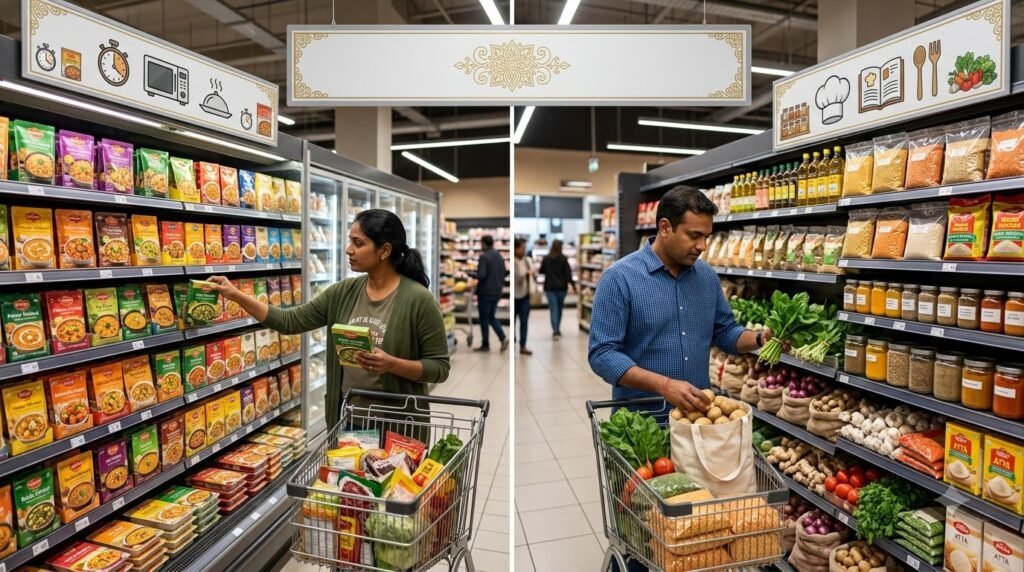
Busy families do not always need another complicated recipe.
Sometimes they need dinner to become possible within twenty minutes.
Home cooking remains central to many Indian households because it gives families control over ingredients, seasoning, portion size and regional preferences. Dal, rice, sabzi, roti, khichdi, sambar and fresh vegetables can form the foundation of everyday meals.
But not every evening allows time for soaking beans, chopping vegetables, preparing dough and building a curry from the beginning.
That is where ready-to-eat Indian food, frozen products and instant mixes can help.
They should not automatically replace home cooking. They can support it on:
- Late workdays
- School and activity nights
- Travel-return days
- Exam weeks
- Sick days
- Guest visits
- Festival-preparation days
- Evenings when the planned vegetables have entered a questionable phase of fridge citizenship
The most practical kitchen combines fresh ingredients, pantry staples and a limited number of convenient backup foods.
Subzi Mandi’s website lists South Asian groceries, fresh produce and rotating weekly specials. Its own grocery content also describes frozen parathas, samosas, curries and other convenient Indian foods as part of its store assortment. Product availability may differ by location.
Is Ready-to-Eat Indian Food Better Than Home Cooking?
Neither option is better for every meal.
Home cooking is usually the better fit when you want:
- Control over oil, salt and spice
- Fresh vegetables
- Family or regional recipes
- Larger quantities
- Flexible portion sizes
- Meals adapted for children or dietary needs
Ready-to-eat or frozen food is useful when you need:
- A fast dinner
- A backup meal
- Low-preparation food
- Snacks for unexpected guests
- Convenient breakfast or lunch
- Something faster than takeout
A balanced family kitchen might use home cooking for most regular meals while keeping two or three frozen breads, ready curries, instant breakfasts or appetizers for difficult days.
Ready-to-Eat, Ready-to-Cook and Frozen Foods Are Not the Same
These terms are often grouped together, but they describe different levels of preparation.
Ready-to-eat
These products can generally be consumed as sold or after simple heating, according to package directions.
Examples may include:
- Shelf-stable dal
- Heat-and-serve rajma
- Ready chana
- Packaged paneer curry
- Prepared rice
- Chutneys
- Pickles
- Packaged snacks
Ready-to-cook
These products still require cooking or preparation.
Examples include:
- Instant poha or upma mixes
- Idli or dosa mixes
- Frozen vegetables
- Uncooked frozen snacks
- Packaged spice-and-grain meal kits
- Prepared batter
Frozen convenience foods
These are stored frozen and may require heating, baking, frying or cooking.
Examples include:
- Parathas
- Naan
- Samosas
- Kebabs
- Pakoras
- Frozen vegetables
- Frozen curries
- Prepared snacks
Always follow the product’s storage and preparation instructions. Do not assume that every frozen product is fully cooked merely because it looks ready.
Use a Three-Layer Family Meal System
Instead of filling the kitchen with random products, build three useful layers.
Layer 1: Home-cooking foundation
Keep enough ingredients for several dependable meals:
- Rice
- Atta
- Two or three dals
- One bean such as rajma or chickpeas
- Cooking oil
- Ghee
- Everyday spices
- Onions
- Tomatoes
- Potatoes
- Ginger
- Garlic
- Yogurt
- Weekly vegetables
These ingredients support meals such as:
- Dal chawal
- Khichdi
- Sabzi and roti
- Rajma rice
- Chole
- Vegetable pulao
- Yogurt rice
- Simple parathas
Layer 2: Fast meal backup
Keep a small selection of products that can become dinner quickly:
- Frozen parathas or naan
- One or two ready curries
- Frozen vegetables
- Instant poha or upma
- Prepared batter
- Ready dal
- Pickle or chutney
The goal is to cover two or three busy meals, not to bury the freezer under twelve nearly identical boxes.
Layer 3: Guest and snack backup
Useful items may include:
- Frozen samosas
- Frozen kebabs or cutlets
- Namkeen
- Biscuits
- Papad
- Tea
- Chutneys
- A modest quantity of sweets
This layer prevents an unexpected visit from becoming an emergency catering operation.
Home Cooking vs Ready-to-Eat Indian Food
| Decision factor | Home cooking | Ready-to-eat or frozen food |
| Preparation time | Usually longer | Usually shorter |
| Ingredient control | High | Limited to the product |
| Flavor adjustment | Easy | May be limited |
| Portion flexibility | High | Package-dependent |
| Best use | Regular meals | Busy days and backup meals |
| Fresh vegetables | Easy to include | May need to be added separately |
| Storage | Pantry, refrigerator or freezer | Depends on package type |
| Planning required | Meal and ingredient planning | Label, storage and pairing planning |
| Cooking skill | May require more | Usually requires less |
| Cost comparison | Often useful for repeated family meals | Can be useful when replacing takeout |
Home cooking is not automatically nutritious merely because it is homemade. A heavily fried or salty homemade meal can still be poorly balanced.
Similarly, packaged food is not automatically unsuitable. Products differ considerably, which is why the ingredient list, serving size and Nutrition Facts label matter.
How to Compare Ready Indian Foods Before Buying
Check the serving size first
Nutrition information is usually listed per serving, and one package may contain more than one serving. Eating the entire package can therefore provide more calories, sodium, saturated fat or added sugar than the single-serving numbers suggest.
Compare:
- Serving size
- Servings per container
- Amount your family will realistically eat
A pouch that appears to serve two people may become one person’s dinner after the first spoonful meets reality.
Compare sodium
Ready curries, snacks, pickles, frozen breads and chutneys may vary substantially in sodium.
Use the label to compare similar products rather than assuming every dal or paneer dish is nutritionally equivalent.
Review saturated fat and added sugars
These may be relevant in:
- Creamy curries
- Fried snacks
- Desserts
- Sweet beverages
- Some frozen breads
The FDA requires Nutrition Facts labels to identify nutrients such as saturated fat, sodium, fiber, total sugars, added sugars and protein.
Look for protein and fiber
A product containing dal, beans or vegetables may provide more meal value than one composed mainly of sauce or refined starch.
Do not evaluate a meal by protein alone. Consider what it will be served with.
Read the ingredient and allergen information
Check for ingredients relevant to your household, including:
- Milk
- Wheat
- Peanuts
- Tree nuts
- Soy
- Sesame
- Other declared allergens
This is especially important when buying food for children, guests or anyone with a known allergy.
Check the preparation method
Compare whether the product requires:
- Microwave heating
- Stovetop heating
- Baking
- Frying
- Thawing
- Water or other additions
A ten-minute product is not especially convenient when the required appliance is unavailable.
The Best Ready Foods Are Easy to Complete
Choose convenience foods that pair with staples already kept at home.
| Convenient product | Add at home | Result |
| Ready dal | Rice, yogurt and pickle | Fast dal-rice meal |
| Ready rajma | Rice and sliced onions | Quick rajma chawal |
| Ready chana | Rice, naan or paratha | Fast chickpea dinner |
| Ready paneer curry | Roti and cucumber | Quick family meal |
| Frozen paratha | Yogurt and pickle | Breakfast or light dinner |
| Frozen samosa | Chutney and tea | Guest or weekend snack |
| Instant poha | Peanuts, lemon and coriander | Faster breakfast |
| Instant upma | Yogurt or chutney | Light meal |
| Frozen vegetables | Fresh masala base and dal | Quick sabzi combination |
| Prepared batter | Chutney and sambar | Convenient breakfast or dinner |
One prepared component plus one fresh component often creates a more satisfying meal than either one alone.
For example:
- Ready dal + rice + cucumber
- Frozen paratha + yogurt + fruit
- Ready chana + salad + roti
- Frozen samosa + chutney + tea
- Instant poha + lemon + peanuts
- Ready paneer + fresh coriander + rice
What Should Usually Be Cooked Fresh?
Home cooking remains particularly useful for:
Vegetable-based meals
Fresh sabzi allows the household to use:
- Seasonal produce
- Preferred cooking texture
- Less or more oil
- Family-specific spice levels
Simple dal and khichdi
These meals can often be prepared in larger quantities and adapted for:
- Children
- Adults
- Light dinners
- Lunches
- Sick days
Roti and rice when time allows
Fresh roti and rice can support both homemade and ready-prepared mains.
Regional family dishes
Recipes with distinctive tempering, texture or family methods may be difficult to reproduce through packaged products.
Meals for specific dietary requirements
When a household needs close control over allergens, ingredients, salt, texture or religious food practices, cooking from verified ingredients may provide greater control.
When Convenience Foods Are Most Useful
Late work or school nights
Keep:
- Ready dal or curry
- Frozen paratha
- Rice
- Yogurt
This creates a meal without ordering delivery.
Breakfast emergencies
Keep:
- Poha or upma mix
- Prepared batter
- Frozen parathas
- Yogurt
- Tea
Unexpected guests
Keep:
- Frozen appetizers
- Chutney
- Namkeen
- Biscuits
- Tea
Travel-return days
Keep shelf-stable or frozen items that remain usable while the refrigerator is otherwise empty.
Festival preparation
Frozen snacks or ready breakfasts can reduce workload while homemade effort is reserved for important mains, sweets or ceremonial foods.
How to Make a Convenience Meal Feel More Complete
Small additions can improve texture, freshness and variety.
Add something fresh
Choose one:
- Cucumber
- Tomato
- Onion
- Coriander
- Lemon
- Fruit
- Simple salad
Add a basic side
Choose one:
- Yogurt
- Raita
- Pickle
- Chutney
- Papad
Add a suitable staple
Choose one:
- Rice
- Roti
- Paratha
- Naan
- Poha
- Upma
Add garnish only when it improves the meal
Possible additions include:
- Fresh coriander
- Ginger
- Lemon
- Kasuri methi
- A simple tadka
Do not add butter, cream, ghee or extra salt automatically. Taste the product first.
A Practical Weekly Backup Plan
A family does not need seven different ready meals.
A compact weekly backup could include:
- One ready dal or bean curry
- One ready vegetable or paneer dish
- One package of frozen parathas or naan
- One frozen vegetable
- One breakfast mix or batter
- One frozen snack
- One chutney
- Yogurt and rice at home
This provides several combinations without repeating the same dinner every night.
Example combinations
Meal 1: Ready dal + rice + yogurt
Meal 2: Frozen paratha + vegetable curry
Meal 3: Instant poha + peanuts + lemon
Snack: Samosas + chutney + tea
If these backup items remain untouched for months, reduce the quantity during the next shopping trip.
Food Storage and Safety
Check the package before buying
Do not purchase food when the packaging is:
- Open
- Torn
- Leaking
- Bulging
- Badly damaged
- Showing signs of thawing and refreezing
The FDA advises shoppers not to buy damaged products, including frozen packages that appear to have thawed and refrozen.
Maintain safe temperatures
The FDA recommends keeping refrigerators at or below 40°F and freezers at 0°F.
Use an appliance thermometer rather than assuming the dial setting reflects the actual temperature.
Follow the label
Pay attention to instructions such as:
- Keep refrigerated
- Keep frozen
- Refrigerate after opening
- Use within a stated period
- Cook thoroughly
- Do not refreeze after thawing
Refrigerate perishables promptly
Foods requiring refrigeration should generally not remain at room temperature for more than two hours, or more than one hour when temperatures are above 90°F.
Avoid cross-contamination
Keep raw meat, poultry, seafood and eggs separate from ready-to-eat foods during shopping, storage and preparation.
The FDA summarizes safe food handling through four principles: clean, separate, cook and chill.
Reheat according to instructions
Follow the package’s specified heating method and time.
When microwaving:
- Use a suitable container
- Stir or rotate when instructed
- Allow standing time
- Check that the food is heated throughout
Shopping at Subzi Mandi in New Jersey
Subzi Mandi’s current contact page lists New Jersey stores in:
- Iselin
- Cherry Hill
- East Windsor
- Hamilton Township
- Parsippany
- Piscataway
Its website promotes South Asian groceries, fresh produce and weekly specials. Subzi Mandi’s own shopping guides also describe frozen parathas, samosas, ready curries, prepared mixes and similar convenience products. Product selection, brands and promotions may vary by store.
Before visiting:
- Check the nearest location.
- Review current weekly specials.
- Make a list of fresh meal ingredients.
- Add only the backup foods your family uses.
- Check refrigerator and freezer space.
- Contact the store when a specific product is essential.
Organize the list into:
- Produce
- Dairy
- Rice and pantry staples
- Ready meals
- Frozen breads
- Frozen snacks
- Chutneys and pickles
- Breakfast products
This helps prevent the freezer section from turning a practical trip into an expedition through fifty versions of dinner.
Common Mistakes Busy Families Make
Keeping only fresh ingredients
Fresh food requires time and preparation.
Better approach: Keep enough backup food for two or three difficult evenings.
Buying too many ready meals
A crowded freezer is not automatically a meal plan.
Better approach: Buy products that pair with staples your household already uses.
Ignoring the serving size
A package may contain multiple servings.
Better approach: Compare nutrition information with the portion that will actually be eaten.
Buying convenience food without fresh sides
Ready curry alone may feel repetitive.
Better approach: Keep yogurt, cucumber, lemons, onions or fruit available.
Assuming every frozen product is fully cooked
Better approach: Read and follow the preparation instructions.
Ignoring older products
Better approach: Rotate the freezer and pantry so earlier purchases are used first.
Using ready food every night because it is available
Convenience can quietly replace planning.
Better approach: Assign ready meals to genuinely busy days and use fresh staples on calmer evenings.
Frequently Asked Questions
Is ready-to-eat Indian food useful for busy families?
Yes. It can provide quick meals for late workdays, school nights, travel days and emergencies. It works best as part of a kitchen that also includes basic pantry staples and fresh foods.
Is home cooking always better?
Home cooking provides greater control over ingredients and seasoning, but its quality still depends on the recipe and preparation. Ready foods vary as well, so compare labels and use each option appropriately.
Which frozen Indian foods are practical to keep?
Frozen parathas, naan, vegetables, samosas and selected snacks can be useful when they match the household’s actual meal habits.
What ready meals pair well with rice?
Dal, rajma, chana, sambar-style dishes, paneer curries and vegetable curries may pair well with rice, depending on the product.
What should I check on a ready-food label?
Check serving size, servings per package, sodium, saturated fat, added sugars, protein, fiber, ingredients, allergens, storage instructions and preparation directions.
How many ready meals should a family keep?
There is no universal number. A practical starting point is enough for two or three disrupted meals, adjusted according to household size and schedule.
How should frozen Indian food be stored?
Keep it frozen according to package directions, maintain the freezer at 0°F and avoid purchasing packaging that appears damaged, leaking or thawed and refrozen.
Where can families buy ready Indian foods in New Jersey?
Indian supermarkets such as Subzi Mandi carry South Asian grocery products. Its current website lists New Jersey stores in Iselin, Cherry Hill, East Windsor, Hamilton Township, Parsippany and Piscataway.
Does Subzi Mandi publish weekly specials?
Yes. Its official website publishes rotating weekly offers. Check the current promotion and applicable store before planning the trip.
Final Takeaway
Busy families do not need to choose permanently between home cooking and ready-to-eat Indian food.
They need a kitchen that can respond to different kinds of days.
Use home cooking for:
- Regular family meals
- Fresh vegetables
- Regional dishes
- Ingredient control
- Larger portions
Use ready-to-eat, frozen or instant products for:
- Rushed evenings
- Backup meals
- Breakfast emergencies
- Unexpected guests
- Travel days
The strongest system has three layers:
- A reliable home-cooking pantry
- Enough convenience food for a few difficult meals
- Simple fresh sides that complete those meals
Subzi Mandi gives New Jersey shoppers access to South Asian groceries across several locations, with fresh produce and rotating specials advertised on its official website.
The goal is not to make every dinner from scratch.
It is to make sure a busy evening still ends with an actual meal.
Build a Flexible Family Grocery Plan at Subzi Mandi
Before shopping, check:
- The week’s busiest evenings
- Meals already planned
- Rice, atta and dal inventory
- Refrigerator and freezer space
- Ready foods already at home
- Product labels and allergens
- Current weekly specials
- Preferred Subzi Mandi location
Buy fresh ingredients for the meals you expect to cook and convenient foods for the evenings likely to ignore that plan.
A useful backup meal should rescue dinner.
It should not become a permanent resident of the freezer.